Post-sale revenue should not run on heroics, hope, or last-minute inspection
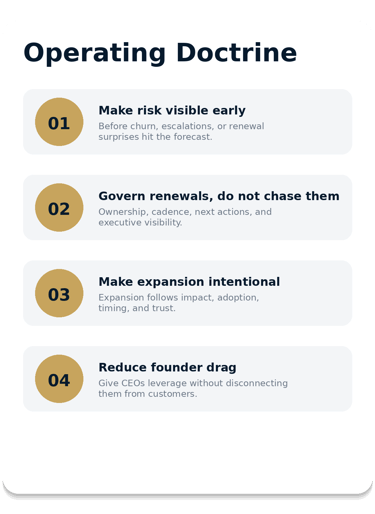
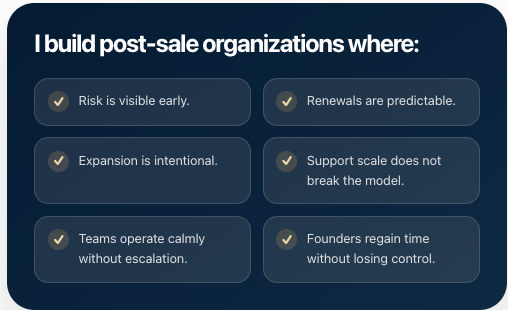
I build customer organizations where risk is visible early, renewals are governed, expansion is intentional, and teams operate calmly under pressure.
Operating manifesto
The core belief
Post-sale is not a support function. It is a revenue engine and a trust system.
When retention and expansion feel fragile, the problem is rarely effort. Most teams are working hard. The real issue is usually operating design: late risk signals, unclear ownership, inconsistent renewal discipline, weak expansion triggers, and too much founder intervention.
That is where customer leadership has to become more than customer management. It has to become a system for protecting revenue quality.
The work is not to add more meetings, more dashboards, or more theater. The work is to turn customer signal into better decisions before revenue moves.


My operating principles
Five rules for building customer organizations that scale without losing control.
These principles shape how I design post-sale teams, renewal governance, customer intelligence, and executive operating cadence.
Systems beat heroics
Heroics create temporary saves. Systems create repeatable outcomes. I build operating models that make customer risk, renewal motion, expansion opportunity, and support capacity visible before they become executive surprises.
01
02
03
04
05
Governance beats hope
Data must govern decisions
Expansion follows impact
Trust scales through clarity
Retention cannot depend on optimism. Renewal confidence comes from inspection cadence, ownership clarity, risk aging, next actions, and executive visibility.
Metrics are not decoration. They exist to guide tradeoffs, align teams, prioritize investment, and improve the quality of executive decisions.
Expansion should not feel like pressure. It should be the natural result of adoption, value realization, trust, and timing.
Trust does not scale through promises. It scales through predictable execution, consistent communication, and accountability by design.
My operating principles
Customer organizations where the system does more of the work.
The goal is not a louder post-sale function. The goal is a calmer one: clear risk, clean ownership, sharper operating cadence, and fewer executive surprises.
How the operating system works
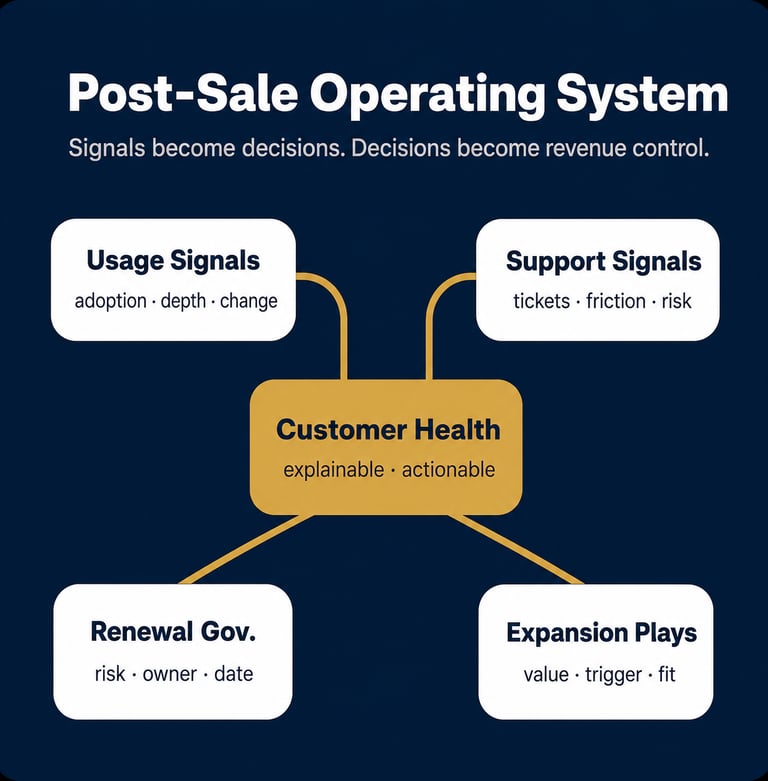
Customer health is not a score. It is a decision system.
Usage signals, support friction, renewal risk, value realization, and expansion triggers need to connect into one operating cadence. When those signals are governed properly, teams stop reacting late and start managing revenue quality with discipline
Adoption, depth, frequency, workflow expansion, and product dependency.
Usage Signals
Support Signals
Renewal Governance
Expansion Plays
Ticket volume, friction patterns, severity, repeat issues, and implementation drag.
Risk ownership, mitigation plans, renewal timing, and executive visibility
Value triggers, stakeholder growth, use-case maturity, and commercial readiness


The leadership standard
The standard is calm execution.
The best post-sale organizations do not feel chaotic from the inside. They have urgency, but not panic. They have accountability, but not blame.
They use data, but do not hide behind dashboards. They know which customers are healthy, which are at risk, which are ready to expand, and which need executive intervention.
They make customer revenue easier to understand, easier to forecast, and easier to improve.
That is the environment I build.
Let’s talk
If post-sale revenue is becoming too important to manage informally, we should talk.
I help CEOs turn customer revenue into a governed operating system: visible risk, predictable renewals, intentional expansion, and less founder drag.
© 2026. Pat Ferdig. All rights reserved.
Post-sale revenue control · Customer Success · Support · Services · Renewals · Operations